

Home / MBBS IN VIETNAM
MBBS in Vietnam 2025-26 : Admission & Fees
MBBS in Vietnam offers a blend of affordable, globally recognized medical education with modern curriculum and growing infrastructure. Programs are conducted in English at select universities, with support for international students and recognition by global medical bodies, making Vietnam an increasingly attractive option for Indian aspirants.
MBBS in Vietnam – Important Links
- Duration
- Eligibility
- Recognition
- Documents Required
- Advantages
- Medical Universities in Vietnam
- MBBS Fee 2025-26
- Medium of Teaching
- MBBS in Vietnam at a Glance
MBBS in Vietnam at a Glance
- Intake: Mainly September, with some universities offering February/April/August intakes. mbbsinvietnam.commymbbsadmission.com
- Eligibility: 50% in PCB + NEET qualification for Indian students
- No National Entrance Exam in Vietnam
- Orientation: Student-friendly communities, on-campus facilities, and orientation support available in large universities
WHY MBBS in Vietnam?
Affordable quality: Offers much lower tuition and living costs compared to Indian private colleges and Western programs.
Recognition: Degrees are recognized by NMC, WHO, FAIMER, and UNESCO, and allow sitting for FMGE/NExT, USMLE, PLAB, etc.
Early clinical exposure: Students begin real patient interaction in hospitals from the first year.
Cultural fit and comfort: Tropical climate and disease patterns match India’s; Indian communities exist with familiar food and festivals.
Duration of MBBS in Vietnam
The MBBS program spans 6 years, consisting of 5 years of academics followed by a 1-year compulsory internship. Some universities may extend it to 6.5 years including extended training.
Medical Courses in Vietnam
| Course | Total Duration |
| MBBS (Bachelor) | 6 Years |
| Dentistry (Bachelor) | 5 Years |
| Pharmacy (Bachelor) | 4 Years |
| Nursing (Bachelor) | 4 Years |
Eligibility Criteria for MBBS in Vietnam
Academic: Completion of 10+2 with Physics, Chemistry, Biology (≥ 50%).
Entrance Exam: No university-level entrance exam required by most institutions.
NEET: Mandatory for Indian students to be eligible for medical licensing in India.
Recognition of Medical Universities in Vietnam
Vietnamese medical universities are recognized by major global bodies including NMC (India), WHO, ECFMG, FAIMER, and WDOMS. Graduates can appear for NEXT (formerly FMGE), USMLE, PLAB, and other licensing exams.
Documents Required for MBBS in Vietnam
The following documents are essential to submit while taking admission to Vietnam medical universities.
- 10th and 12th mark sheets
- Birth certificate (English)
- Passport (valid)
- Migration/Transfer certificate
- NEET scorecard
- Bank statement showing sufficient funds
- Passport-size photographs
- Admission/Invitation letter from the universities
Admission Process for MBBS in Vietnam
Check eligibility: Generally, 10+2 with PCB (minimum 50%), NEET required for Indian students.
Submit application: Apply online or via consultancies (Jan–July), receive admission letter within 15–30 days.
Pay fees and apply for visa: Ministries process visa in 45–60 days. Courses typically start in September/October.
Timeline for MBBS in Vietnam
| Month / Period | Activity |
|---|---|
| January – March | Research universities, check eligibility criteria, and prepare required documents (passport, 10+2 marksheets, NEET scorecard, photos). |
| April – June | Start the application process for preferred universities; submit application forms and pay the application fee. |
| May – July | Receive the admission letter from the university (usually within 15–30 days after applying). |
| July – August | Pay the initial tuition or seat confirmation fee; start preparing for visa documentation and medical check-ups. |
| August – September | Apply for the student visa; visa processing usually takes 45–60 days. |
| September – October | Receive visa approval, book flight tickets, and make travel arrangements. |
| October | Arrive in Vietnam, complete university enrollment and orientation sessions. |
| October – November | Official commencement of the MBBS academic session. |
Advantages of MBBS in Vietnam
Affordable Fees: Tuition ranges from INR 1,16,250 to INR 3,00,000 per semester, significantly lower than many other international options.
Low Cost of Living: Monthly expenses for accommodation, food, transport are generally USD 300–600 (~₹24,000–48,000).
Safe and Student-Friendly: Vietnam ranks among the safest countries in Southeast Asia with a growing Indian student community.
English-Medium Programs: Many universities offer MBBS entirely in English with international faculty.
Multiple Intakes: Universities like Hong Bang, Duy Tan, Can Tho offer intakes in August/September and sometimes February/April.
MBBS in Vietnam Fee Structure 2025-26
Tuition Fees: Approx. ₹1.5 lakh to ₹3.0 lakh per semester (~₹3–6 lakh per year).
Examples:
Can Tho University: $2,250 per semester (~₹1.8 lakh)
Phan Chau Trinh University: $2,750 (~₹2.2 lakh) per first semester only ([search2])
Annual Range: $3,000–$6,000 (~₹2.5–5 lakh)
Living Costs: ₹12,000–30,000/month (USD 300–600), hostel ₹80,000–1.2 lakh/year ([search9], [search8])
Total 6-year Cost: Approximately ₹25–35 lakh (some reports indicate up to ₹40–60 lakh based on location & lifestyle) ([search5], [search8], [search6])
Medical Universities in Vietnam
Top institutions accepting international students include:
Hanoi Medical University (est. 1902) — most prestigious public university.
Ho Chi Minh City University of Medicine and Pharmacy — well-known for medical and pharmacy programs.
Can Tho University of Medicine and Pharmacy — good for cost-effective programs.
Duy Tan University, Hong Bang International University, Hue University, Hai Phong University, Pham Ngoc Thach University, Vietnam Military Medical University, Thai Binh, Thai Nguyen Medical University — among the 20+ recognized medical schools in Vietnam serving Indian students.
Syllabus for MBBS in Vietnam
Pre-Clinical (Years 1–2): Anatomy, Physiology, Biochemistry.
Para-Clinical (Years 3–4): Pathology, Microbiology, Pharmacology.
Clinical (Years 5–6): Medicine, Surgery, Pediatrics, OBGYN, etc., with internships and hands-on clinical rotations.
Medium of Teaching in Vietnam Medical Universities
Primarily English for international MBBS programs.
Vietnamese language training may be offered for clinical rotations and patient interaction.
Disadvantages of MBBS in Vietnam
Language Barrier: Clinical interaction outside English-medium context may require Vietnamese proficiency.
Homesickness & Cultural Adjustment: Extended program duration, different food, and lifestyle can be challenging for some.
Accommodation Access: Hostel spots can be limited; private housing may be needed, especially in major cities.
Limited Scholarships: Financial aid for international students is limited, often highly competitive.
About Vietnam
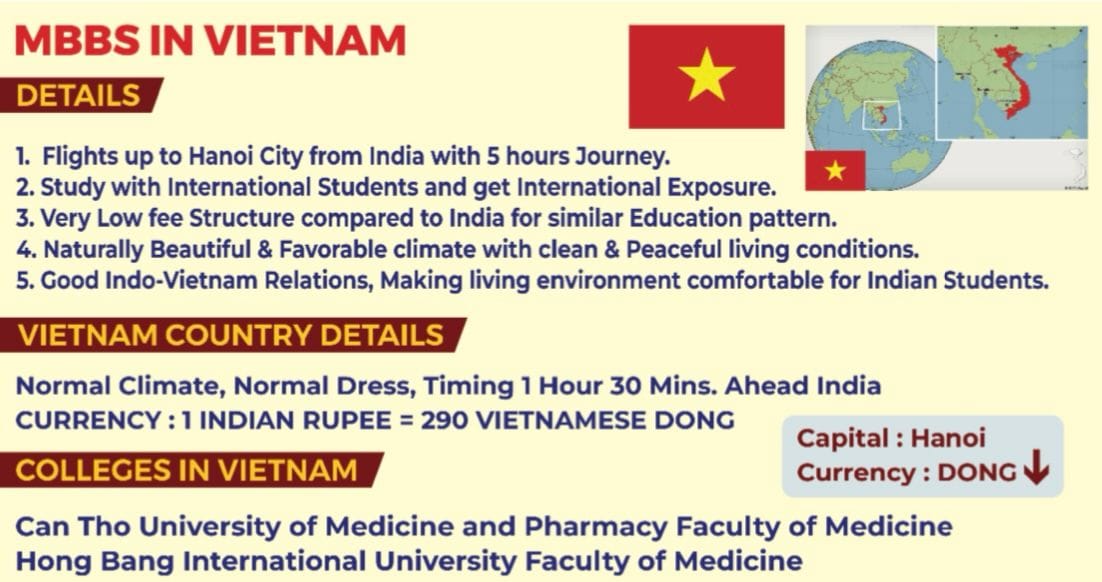
Vietnam is a Southeast Asian nation bordered by China, Laos, and Cambodia, with a tropical climate and vibrant cultural landscape. The capital is Hanoi; Ho Chi Minh City is its economic hub. Vietnam is known for its affordability, safety, and growing education infrastructure.
Advice for the Students
Prepare early: Begin your application and visa process 6–8 months before intake.
Learn basic Vietnamese: It helps with daily life and patient interactions.
Choose recognized institutions: Ensure the university is in WHO/WDOMS listings and NMC-approved.
Be ready for adaptation: The environment, clinical system, and culture will be different—stay open-minded and proactive.
FAQ for MBBS Study in Vietnam
Q1: Is NEET required to study MBBS in Vietnam?
Yes, Indian students must qualify NEET to be eligible for MBBS admission in Vietnam as per the Medical Council of India (NMC) guidelines.
Q2: What is the duration of MBBS in Vietnam?
The MBBS course in Vietnam generally takes 6 years to complete, including 1 year of internship or clinical rotations.
Q3: What is the medium of instruction for MBBS in Vietnam?
Most medical universities in Vietnam offer MBBS programs in English for international students, along with Vietnamese language training for clinical practice.
Q4: Is MBBS in Vietnam recognized in India?
Yes, if you graduate from an NMC-approved Vietnamese medical university, you can appear for the FMGE (Foreign Medical Graduates Examination) in India.
Q5: What is the average cost of studying MBBS in Vietnam?
The tuition fees range between USD 4,000 – 7,000 per year, excluding hostel, food, and other living expenses.
Q6: Can I work while studying MBBS in Vietnam?
No, Vietnam generally does not permit international students to work part-time while holding a student visa.
Q7: Is Vietnam safe for international students?
Yes, Vietnam is considered safe for students, with a welcoming culture and low crime rates in university towns.
Q8: When does the academic session for MBBS start in Vietnam?
Most universities start their MBBS academic session in October or November each year.